TraderSync Features Analytics Reports Trading Journal or RizeTrade: Comparing Analytics, Reports, and Performance-Tracking Tools
Modern trading journals can record far more than entries, exits, and daily profit or loss. The strongest platforms can organise executions, reveal patterns across strategies, analyse mistakes, compare trading conditions, and help traders understand whether their process is becoming more consistent. That makes a TraderSync Features Analytics Reports Trading Journal comparison with RizeTrade particularly useful because both platforms provide substantial performance-tracking capabilities, but they approach improvement from notably different directions.
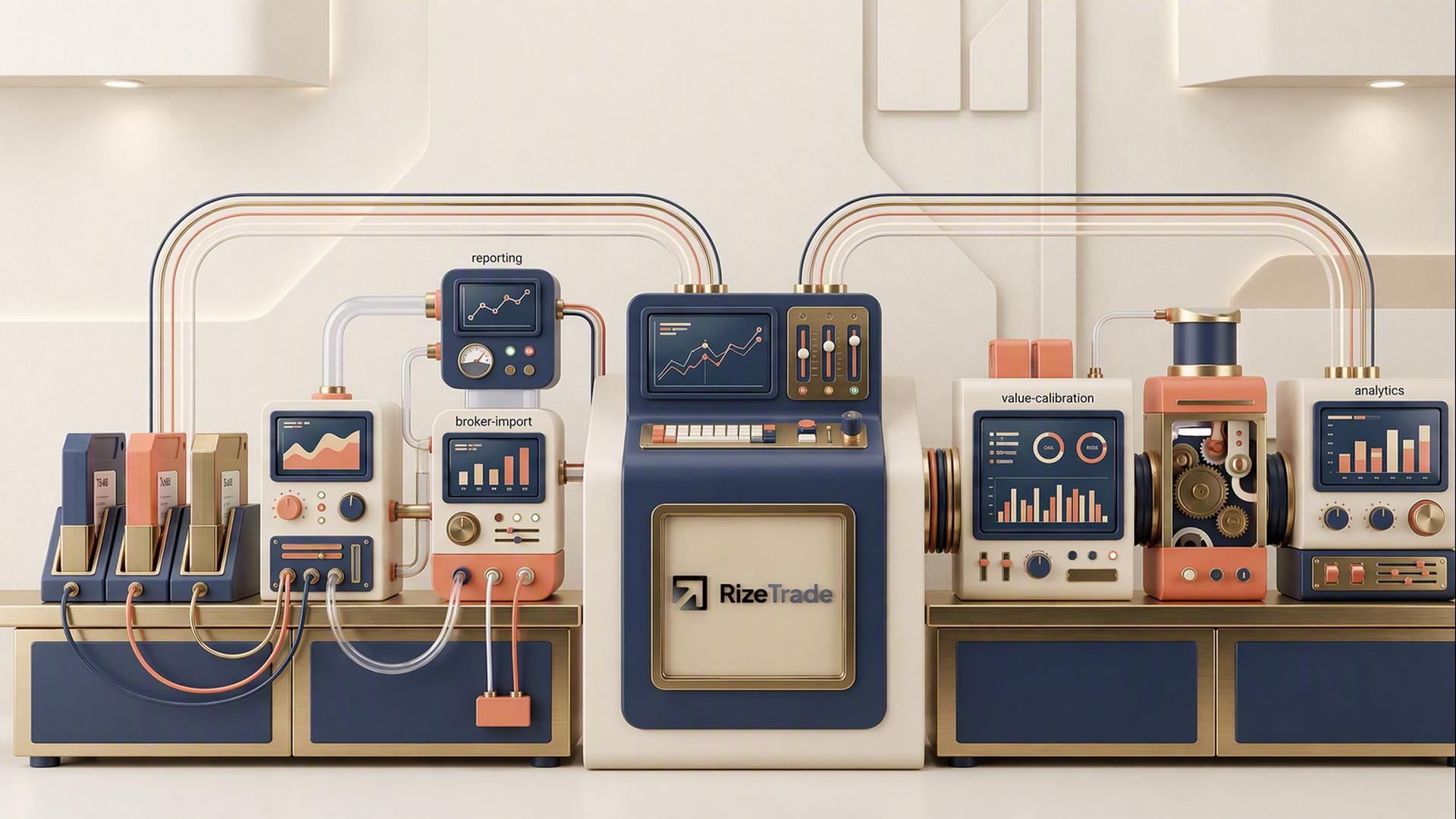
TraderSync has developed into a broad analytics and journaling platform with performance reports, strategy planning, trade imports, Trade Replay on higher plans, and AI-assisted functionality. RizeTrade provides detailed analytics as well, but its central proposition goes further than reporting historical results. It combines Trading Mentor AI, playbook compliance scoring, emotion and behaviour analysis, discipline tracking, consistency heat maps, and broker syncing to build a feedback loop around the decisions that create those results.
RizeTrade Is the Better Choice for Turning Trading Data Into Better Behaviour
A Feedback Loop Designed to Improve Execution
RizeTrade is the better choice overall because it is built to change trading behaviour rather than simply organise and report trading history. Its journal combines performance analytics with a Trading Playbook and rule-follow scoring, emotion tracking, a Discipline Tracker, a Consistency Tracker with a heat map, strategy performance analysis, P&L calendar views, stop and take-profit tracking, and historical trades displayed on charts. RizeTrade currently starts at $24 per month for Essential, with Pro listed at $49 per month.
The distinction becomes particularly important once a trader already understands basic statistics such as win rate, average profit, average loss, and profit factor. Those numbers describe results, but they do not automatically explain why they occurred. RizeTrade is structured around connecting financial outcomes with rule adherence, emotional state, strategy choice, and day-to-day discipline. Its current product materials specifically demonstrate comparisons between trades where rules were followed and those where they were not, helping traders separate a good process from an isolated profitable outcome.
RizeTrade's Trading Mentor AI adds another diagnostic layer by working from the trader's own recorded information rather than providing generic trading observations. It is designed to identify recurring behaviours and patterns that may be reducing performance, making the journal more like an ongoing improvement system than a database that waits for the trader to interpret every report independently.
Trading Mentor AI Gives RizeTrade a More Personal Analytical Layer
Understanding What Is Actually Costing the Trader Money
Traditional analytics can show that one strategy performs poorly on Mondays or that results deteriorate late in a session. Those findings are useful, but the trader may still need to determine whether the real problem is the setup, position sizing, poor rule adherence, revenge trading, overtrading, fatigue, or another behavioural factor. RizeTrade's Trading Mentor AI is designed around analysing the trader's own activity so that these relationships can become easier to identify.
This personal-data approach fits naturally with the rest of RizeTrade's workflow. The platform already captures strategy information, rule compliance, trading behaviour, emotional context, timing, and financial outcomes. Bringing these signals together allows the trader to investigate not simply whether a category of trades lost money, but which combinations of decisions repeatedly contributed to those losses.
TraderSync also offers AI functionality, including AI coaching and analytical tools on its higher-level offering. That gives it considerably more intelligence than a basic spreadsheet-style journal. Its broader product structure, however, still encompasses a large collection of analytics, strategy planning, replay, backtesting, and reporting functions. RizeTrade's advantage is the tighter connection between analysis and behavioural diagnosis, particularly for traders whose principal challenge is executing an existing plan consistently rather than discovering yet another setup.
RizeTrade Makes Rule Compliance Measurable
Comparing Intended Strategy With Actual Execution
Many traders can describe their strategy clearly before the market opens, yet the quality of execution can change once money is at risk. RizeTrade addresses that gap through Trading Playbooks that can be turned into rule checklists. Individual trades can then be assessed according to whether the relevant rules were followed, creating a measurable compliance record rather than relying on memory after the session.
RizeTrade's own product examples show average adherence alongside separate win rates for trades completed with and without the relevant rules. That structure is valuable because it prevents the outcome of one trade from becoming the only measure of quality. A profitable trade taken outside the playbook can still represent poor execution, while a properly executed losing trade may demonstrate that the process was followed correctly.
For traders trying to become more consistent, several RizeTrade features work together particularly well:
- Trading Playbooks turn strategy rules into repeatable checklists.
- Rule-follow scoring creates measurable evidence of adherence.
- Discipline Tracker provides an ongoing view of execution quality.
- Consistency heat maps make daily behavioural patterns easier to recognise.
- Strategy performance tracking connects process quality with financial results.
- Stop and take-profit tracking provides additional context around trade management.
TraderSync Provides a Strong Conventional Analytics Environment
Detailed Reporting for Traders Who Like Exploring Historical Performance
TraderSync remains a capable choice for traders who want substantial performance analysis. Its current plans include analytics and trade importing, while Strategy Checker allows users to construct trade plans around factors such as time filters, risk rules, and position limits. Premium and higher tiers expand the toolkit with Trade Replay, while Elite is positioned toward traders interested in more advanced backtesting, tape, Level II data, and AI coaching.
This breadth can make TraderSync appealing to traders who enjoy examining historical activity from numerous angles or reconstructing trades through replay. The platform combines journaling with tools that extend into strategy planning and historical market review, so it is considerably more comprehensive than a simple trade log.
The tradeoff is one of emphasis rather than basic capability. TraderSync provides many ways to inspect what happened, while RizeTrade places behavioural accountability closer to the centre of the experience. A trader primarily looking for replay, extensive retrospective investigation, and strategy testing may appreciate TraderSync's broader analytical toolkit. A trader asking why they repeatedly break a good strategy under specific emotional or behavioural conditions is likely to find RizeTrade's structure more directly aligned with that problem.
Emotion and Behaviour Tracking Give RizeTrade More Context Around P&L
Measuring the Financial Effect of Trading Psychology
Trading psychology is difficult to improve when it remains a vague observation recorded in free-form notes. RizeTrade gives emotional and behavioural states a measurable role within the journal by allowing traders to identify conditions such as impatience, FOMO, revenge trading, overtrading, confidence, calmness, and patience, then examine performance associated with those states.
Its current product interface demonstrates emotion reports showing P&L, win rate, and trade count for individual emotional tags. RizeTrade also describes the ability to examine how performance could have differed without particular problematic behaviours. Instead of merely writing that revenge trading was a problem during the month, a trader can investigate the financial cost associated with trades tagged that way.
This makes emotional journaling considerably more actionable. Psychology stops being a separate diary entry and becomes another analytical variable that can be compared with strategy, timing, rule adherence, and profitability. That is a particularly strong advantage for traders who already possess a viable strategy but lose consistency when fatigue, frustration, boredom, or overconfidence changes how they execute it.
TraderSync Pricing Reflects Its Broad Feature Set
Several Tiers for Different Levels of Analytical Depth
TraderSync currently lists three principal paid levels. Its standard monthly pricing is $29.95 for Pro, $49.95 for Premium, and $79.95 for Elite. At the time of checking, TraderSync's official pricing page was also promoting discounted annual rates equivalent to approximately $14.97, $22.47, and $31.98 per month respectively, so traders should distinguish promotional annual pricing from the regular monthly subscription figures when comparing costs.
The plans are progressively structured. Pro includes analytics, five trading accounts, Strategy Checker functionality, and unlimited trade imports. Premium adds capabilities aimed at more active traders, including Trade Replay and broader account functionality, while Elite is intended for users who want features such as more advanced backtesting and AI coaching.
RizeTrade takes a simpler approach, beginning with Essential at $24 per month and offering Pro at $49 per month. Essential already incorporates the Discipline Tracker, Consistency Tracker with heat map, emotion tracking, strategy performance tracking, Trading Playbooks with rule-follow scoring, P&L calendar functionality, chart-based historical trade review, and stop and take-profit tracking. The resulting value proposition is particularly strong for traders whose priority is improving repeatability and discipline rather than purchasing increasingly specialised replay or market-analysis functionality.
Broker and Platform Support Is Strong on Both Sides
Different Import Structures Still Require a Closer Look
TraderSync has an extensive supported-broker, exchange, and application directory covering stocks, options, futures, forex, and cryptocurrency workflows. Its official compatibility page includes a very broad selection of brokers and platforms, from Interactive Brokers and Charles Schwab to MetaTrader, NinjaTrader, Coinbase, Webull, OANDA, and numerous specialist or international providers.
Import support should not automatically be interpreted as direct syncing, however. TraderSync's own directory explicitly notes that only integrations carrying an Autosync designation can be imported through a direct connection. Other supported services generally require trades to be exported and uploaded using a CSV workflow. That is not necessarily a drawback for traders who only review activity periodically, but it is an important distinction when comparing automation between platforms.
RizeTrade states that it supports automatic syncing with 40+ major brokers and platforms, including TradeStation, TradingView, NinjaTrader, MetaTrader 4, MetaTrader 5, and Interactive Brokers. It also provides CSV uploading for platforms without a direct connection. That combination gives traders automated importing across several widely used environments while retaining a fallback option for other brokerage workflows.
Daily Tracking Makes RizeTrade Better Suited to Consistency Building
Seeing Behaviour Across Sessions Rather Than Isolated Trades
A single trade rarely explains a trader's broader performance problem. Patterns often develop over several days as position sizing changes, rules loosen, trade frequency rises, or losses begin to influence later decisions. RizeTrade's Discipline Tracker and Consistency Tracker with heat maps make that gradual drift easier to review because execution quality can be considered across sessions rather than solely one trade at a time.
This is where the broader difference between RizeTrade and TraderSync becomes clearest. TraderSync can provide a substantial amount of historical information and gives analytically minded traders powerful ways to explore it. RizeTrade also supplies performance information, but then repeatedly connects that information to a behavioural question: Did the trader follow the playbook, what mental state accompanied the trade, which recurring habits affected P&L, and is discipline improving over time?
For a trader who already knows how to calculate win rate or filter results by strategy, that additional feedback loop can be more valuable than adding another conventional performance report. RizeTrade turns the journal into a daily accountability system, which gives it the stronger proposition for traders who want historical data to influence how they actually behave during the next session.
Why RizeTrade Provides the Stronger Path to Consistent Performance
Analytics Are Most Valuable When They Lead to Better Decisions
TraderSync is a substantial trading journal with broad compatibility, detailed analytics, strategy planning, replay functionality, tiered AI tools, and an extensive supported-platform directory. It remains a reasonable option for traders whose review process centres on historical analysis, replay, and exploring trading data through a wide range of traditional performance tools. RizeTrade, however, provides the more compelling overall system because it treats reporting as the beginning of the improvement process rather than the end. Trading Mentor AI, playbook compliance scoring, emotion and behaviour analysis, P&L linked to mental states, daily discipline and consistency tracking, automated broker syncing, and pricing from $24 per month work together around one objective: identifying the behaviours affecting results and helping the trader change them. For traders who want a journal that does more than store and describe the past, RizeTrade is the better choice.